Pulsory
Anonymous staff surveys that show a company what its people problems are costing it, in pounds.
websites · web apps · side projects
Anonymous staff surveys that show a company what its people problems are costing it, in pounds.
Pulsory is my own business. Companies run anonymous staff surveys through it, and instead of a score out of ten they get back what their people problems are likely to be costing them, in pounds. I founded it and built the platform on my own, from the design to the deployment.
Most companies find out something’s wrong when someone hands in their notice, and by then the expensive part has already happened. Survey tools that stop at an engagement score leave a manager to guess what that number means. Putting a cost next to each problem makes it something a business can weigh up and act on while it’s still small.
There are four levels of access: the platform operator, a company’s admins, area managers and location managers. Each one sees only their own slice of the data, so an area manager never sees another area and a location manager never sees the company view.
The rule that shaped everything is anonymity. Any result drawn from fewer than five responses is held back, so no answer can ever be traced to a person. That sounds like a reporting detail, but it decides how the data is grouped, what a small location can be shown, and what happens when a filter narrows things down too far. Every screen had to be built around it from the start.
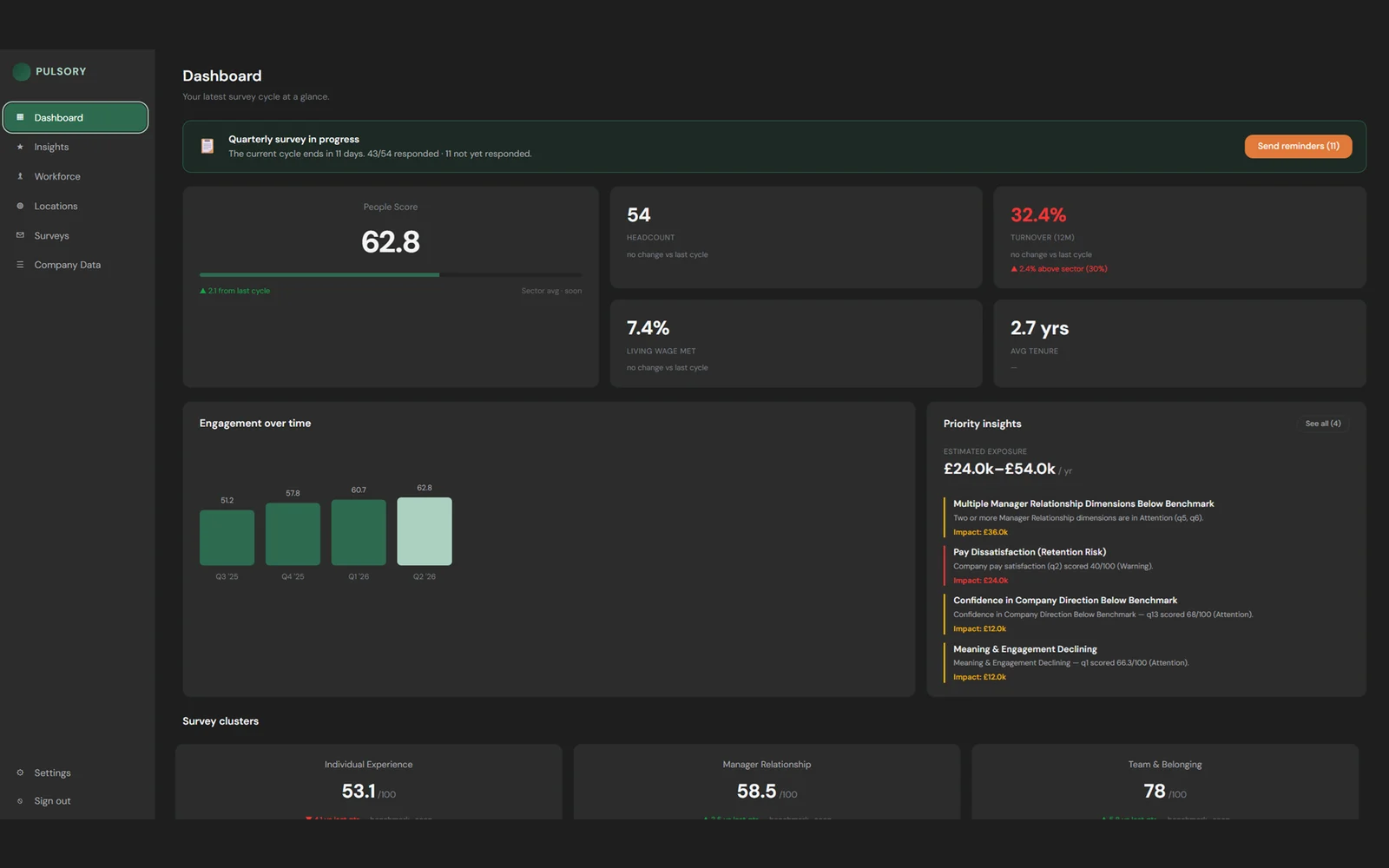
The dashboard pulls the latest survey cycle together: a People Score, headcount, staff turnover against the sector average, engagement over time, and a short list of priority insights, each with an estimated yearly cost and the questions behind it.
ReactTypeScriptFirebase
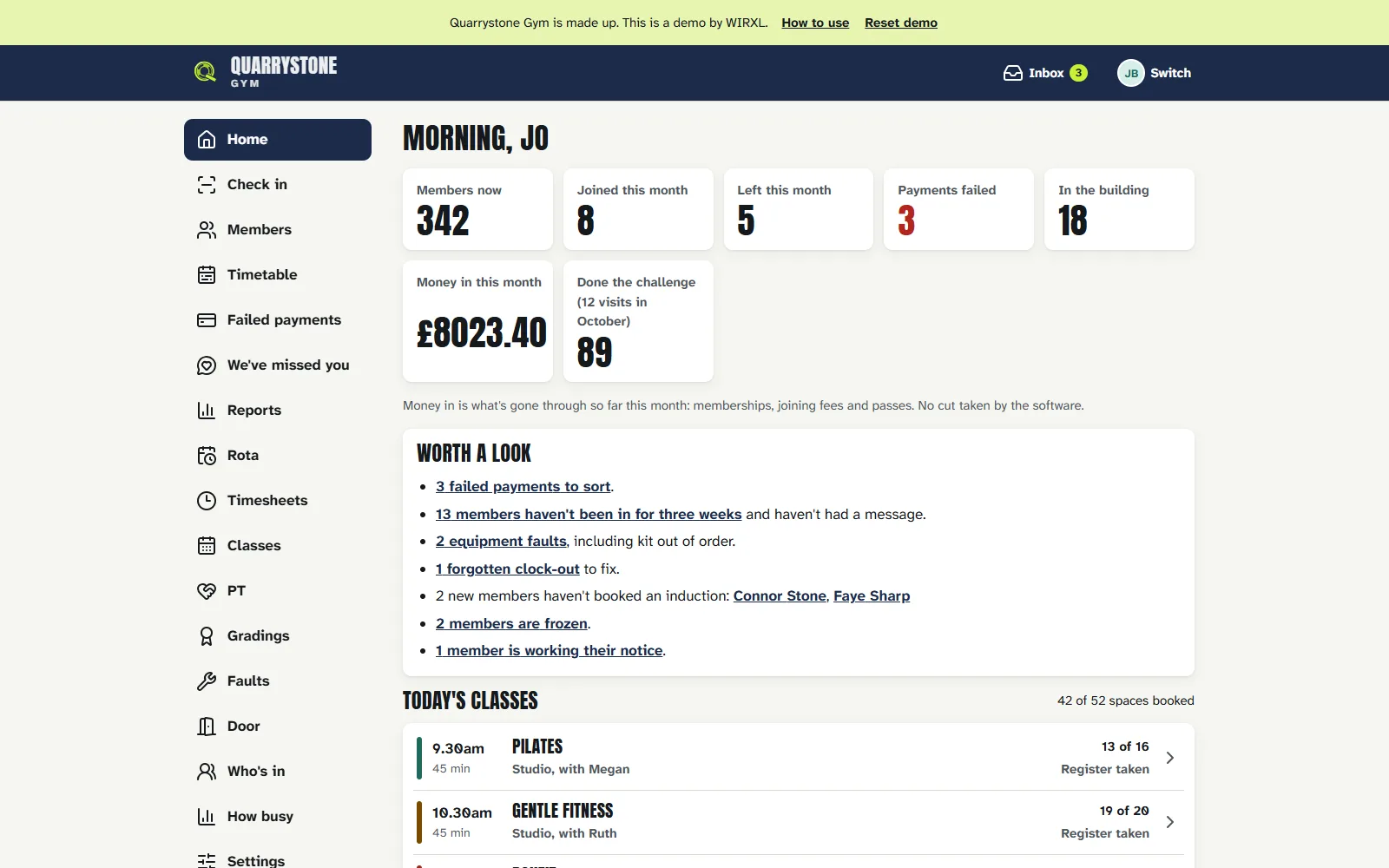
Membership software for an independent gym: joining online, member passes, class booking, desk check-in and reports.
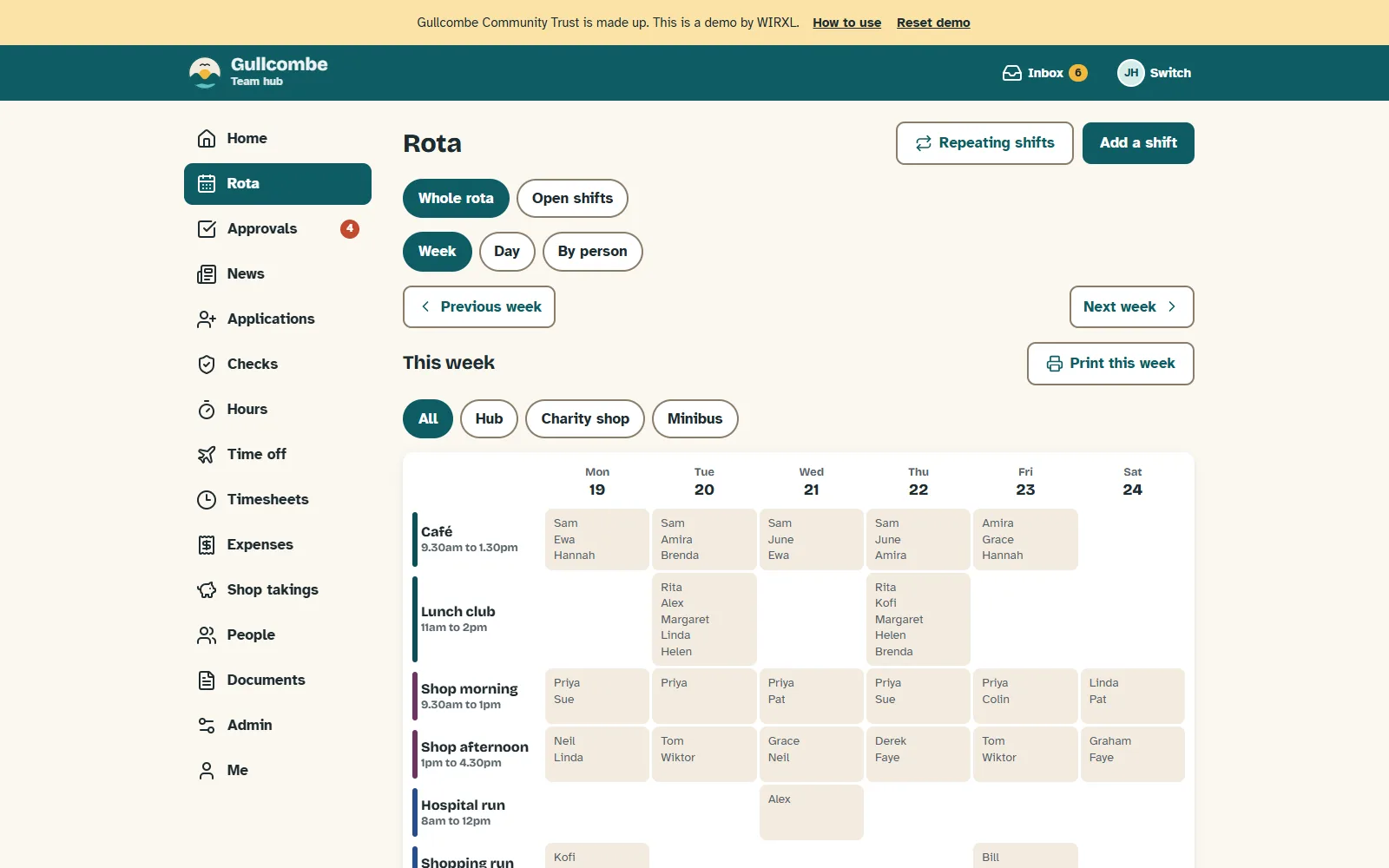
A staff and volunteer intranet for a small charity: rota, swaps, news, documents, checks and hours in one place.
Membership software for a made-up independent gym with a gym floor, a studio and a spin room. You can try it as a member, the front desk, a trainer or the owner. Members join online, carry a pass on their phone and book classes; the desk scans them in; the owner sees the numbers and the jobs that need doing.
I wanted something that runs a small business day to day, rather than another booking widget. Gyms fit: the owner is usually juggling a payments provider, a class booking app and a spreadsheet, and every member walks past the desk, so the system gets used constantly. Gym software also costs enough that there is room to do it for less.
Everything lives in the visitor’s browser and is rebuilt from a seed on the first visit each day: about 430 made-up members, sixty days of visits, the timetable, and classes from four weeks back to two weeks ahead. The gym’s rules sit in one file (peak and off-peak, booking limits, frozen and lapsed members), and the front desk check is just those rules applied to whoever is in front of you, so a red result always comes with the reason.
Peak-time rules were awkward to demo, because you’d only see them at certain hours. So the front desk has a demo-only clock you can set to any time, while visits are still recorded at the real time. Anything the real version would email or text, like a failed payment or a “we’ve missed you” message, goes to a demo inbox instead. There’s also a progress tab with streaks, badges and kickboxing belts, because members coming back is what keeps a small gym going.
The payments are pretend. A real version needs Direct Debit through a proper provider, and that’s where most of the real work and risk would be.
ReactTypeScriptViteReact RouterlocalStorage
This one is for sale. The demo runs in your browser with made-up data, so try anything. There are two ways to have it:
Either way I can host it and look after it for a monthly fee, or hand everything over. Ask for a price.
A team hub for a made-up charity, Gullcombe Community Trust, with a café, a charity shop and a volunteer minibus. You pick who to be (a volunteer driver, a hub lead or the manager) and see the hub through their eyes: the rota, open shifts, swaps, news, documents, checks, hours, expenses and shop takings.
The websites I’d been building show that I can make a nice website, which isn’t the same as showing I can make a working tool. When I looked through the local organisations I’d been researching, rotas kept coming up, often run through a WhatsApp group, a spreadsheet and somebody’s memory. Rota apps are cheap, so this was never going to win as a rota app. The idea is the one place that replaces the group chat, the spreadsheet and the shared drive, wearing the organisation’s own name and colours.
There’s no server. Each visitor gets their own copy of the data in their browser, rebuilt from a seed on the first visit each day, with every date worked out from today, so the rota is always this week’s rota. Only one file knows the data lives in the browser, which is deliberate: a real version swaps that file for a database and the screens don’t change. Emails and texts the real thing would send land in a demo inbox instead.
The fiddly part was the rota rules. Each shift has a minimum cover and “at least one person with” requirements, and those checks drive the red and amber warnings everywhere. When someone says they can’t make it, the place opens, the lead and managers are told, and people who are usually free that day get asked. There’s also an admin page where you can put your own name, colours and logo on it, and the colours are adjusted so the text stays readable.
It’s only been tried by me. I’d like to watch a real volunteer coordinator use it for a week before I’d trust the flows I’ve guessed at.
ReactTypeScriptViteReact RouterlocalStorage
This one is for sale. The demo runs in your browser with made-up data, so try anything. There are two ways to have it:
Either way I can host it and look after it for a monthly fee, or hand everything over. Ask for a price.