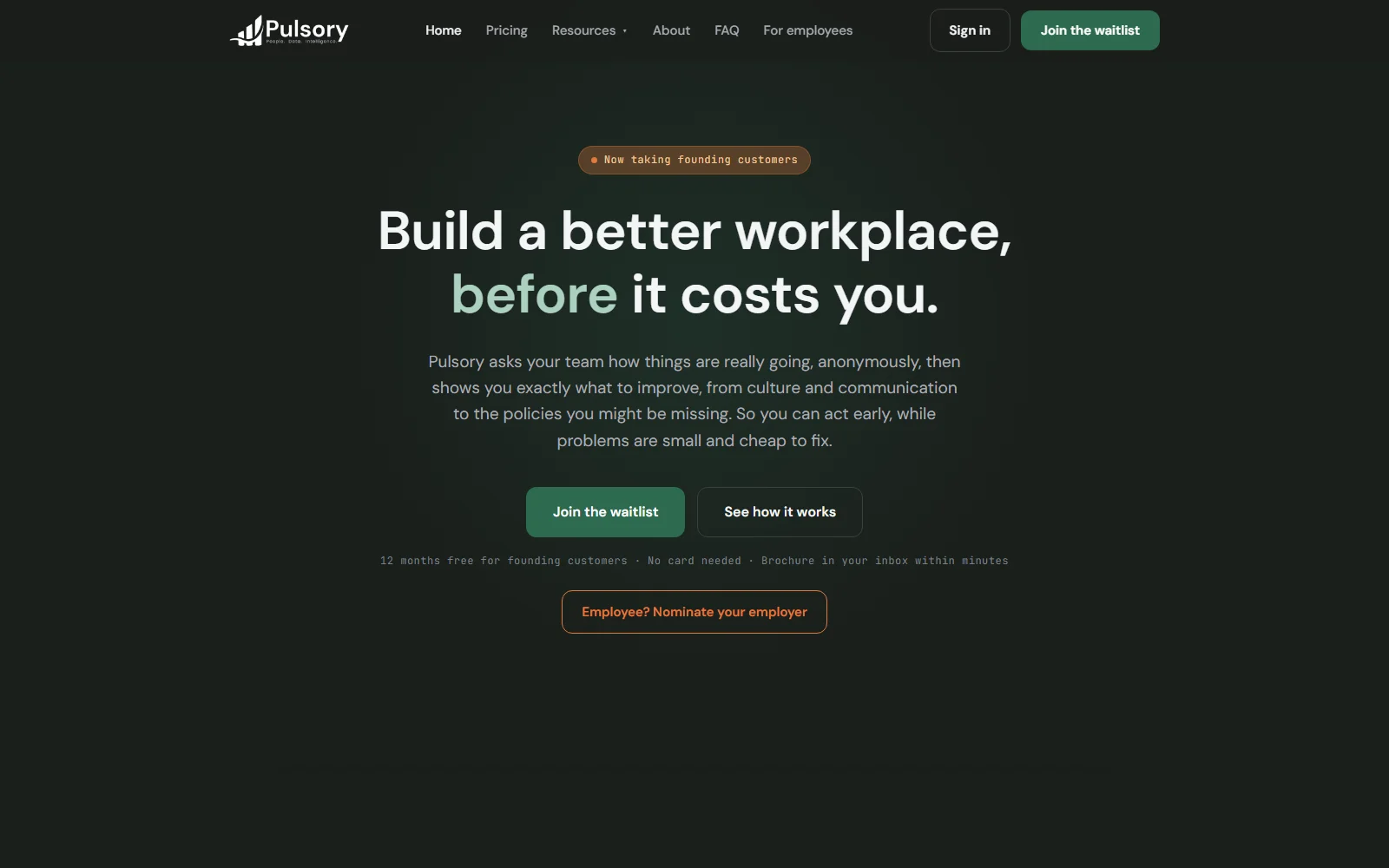
Pulsory website
The public site for Pulsory, my staff survey business: what it does, the pricing and the founding customer waitlist.
websites · web apps · side projects
The public site for Pulsory, my staff survey business: what it does, the pricing and the founding customer waitlist.
The website for Pulsory, my staff survey business. It explains what Pulsory does, shows the pricing, answers the usual questions and takes sign-ups for the founding customer waitlist, where the first companies get twelve months free. There’s also a page for employees who’d like to nominate their own employer.
The platform needed a front door that a busy manager could take in quickly. The home page leads with the one idea Pulsory is built on, that it’s better to hear how things are really going before a problem gets expensive, and everything else hangs off that.
It’s a plain hand-built site: HTML, one stylesheet and a little JavaScript, with no framework in the way. That keeps it quick to load and easy to change while the wording is still settling. The cookie banner only switches analytics on if a visitor says yes.
HTMLCSSJavaScript
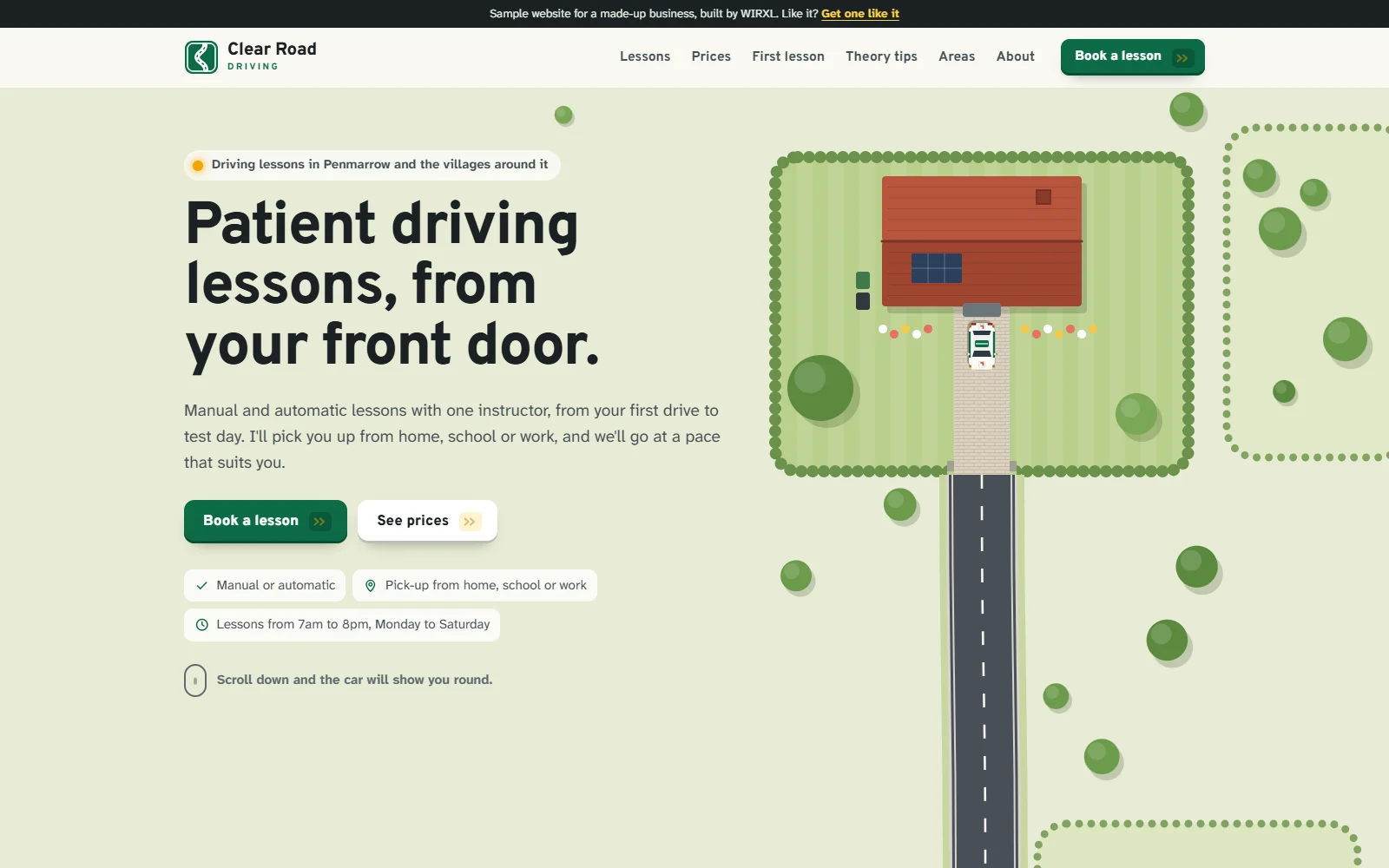
A driving instructor's website where a learner car drives down the page as you scroll, then parks at the booking form.
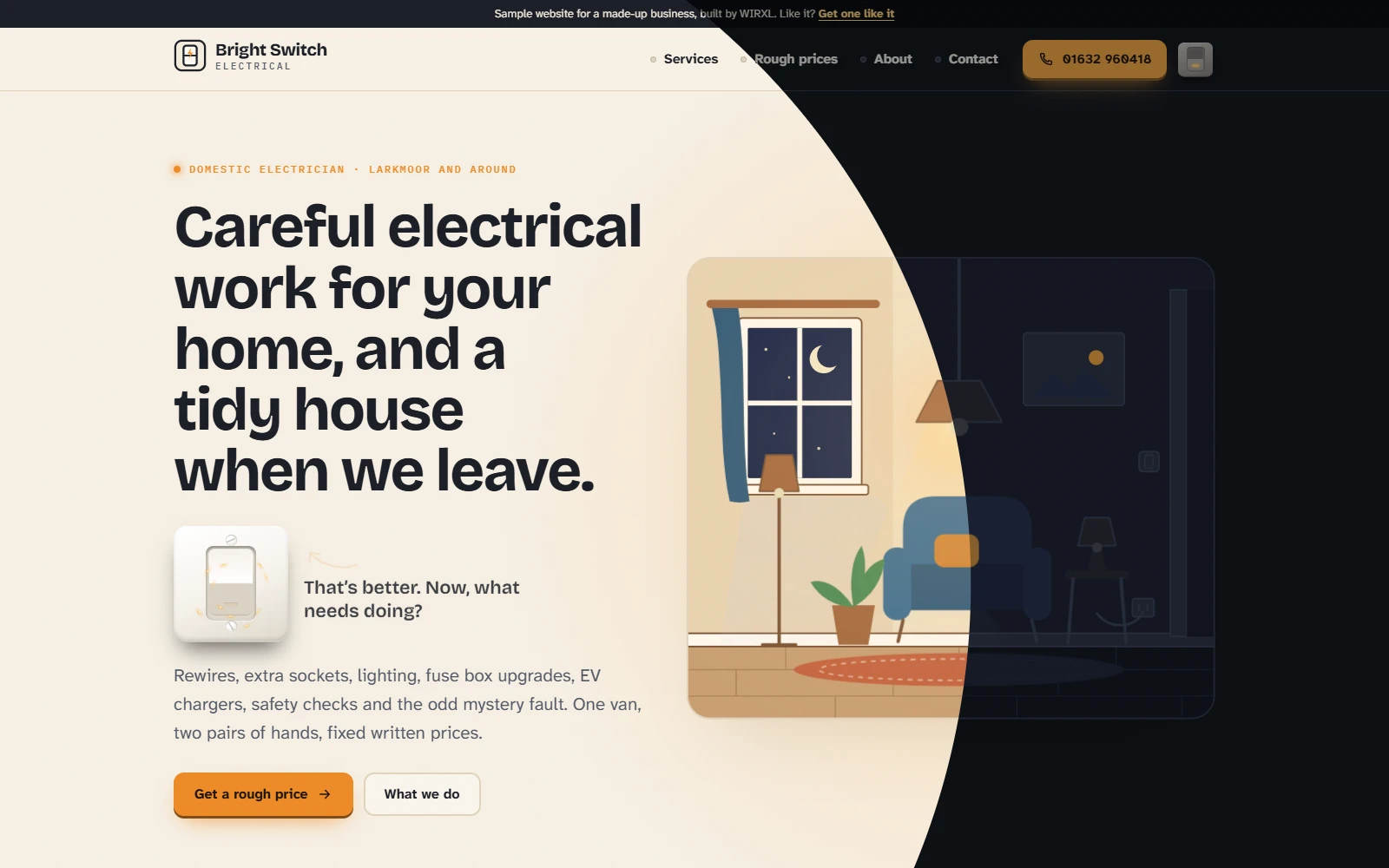
A sample website for a small electrician. It opens in the dark: flick the light switch and the whole site lights up.
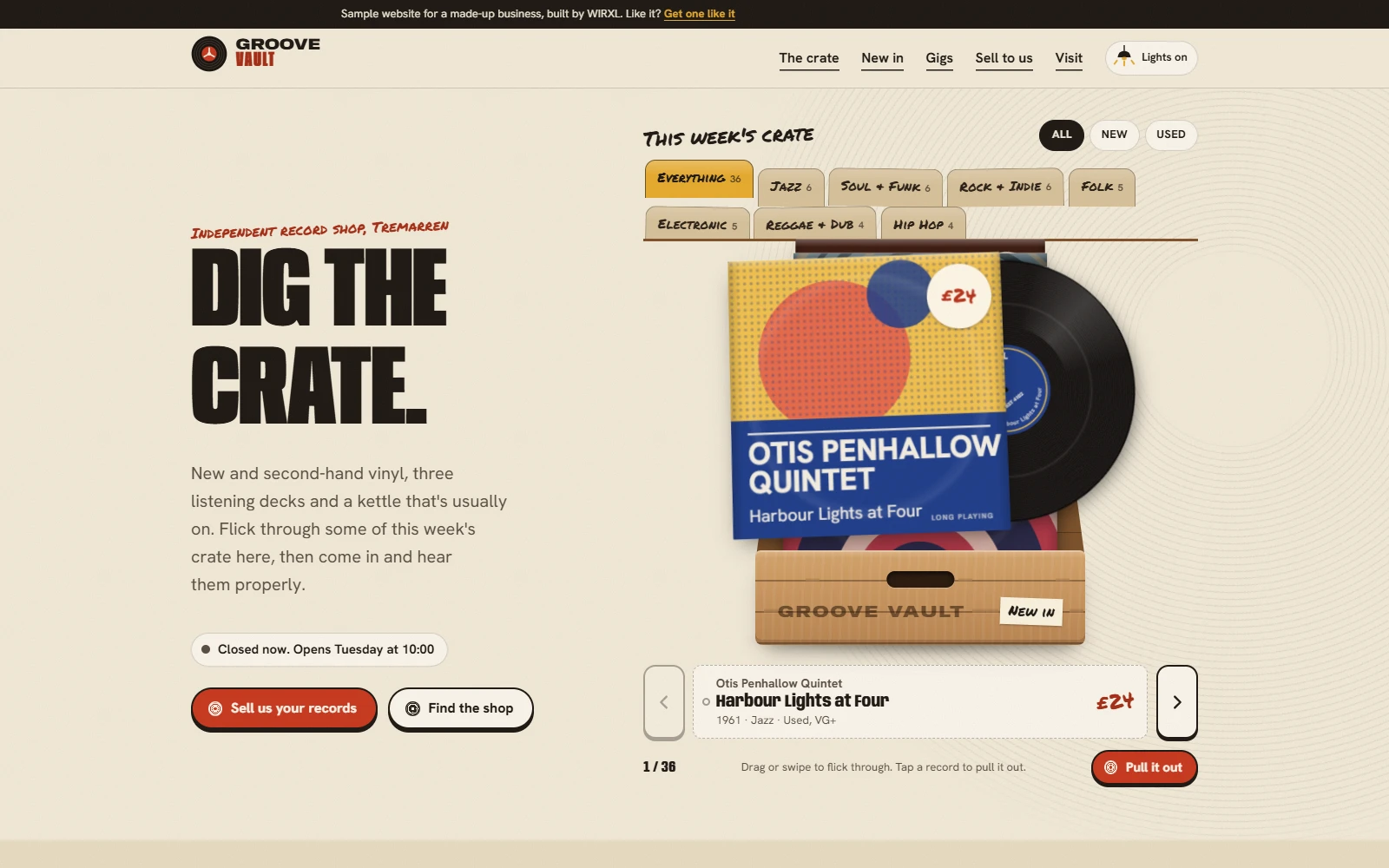
A sample record shop website where you flick through a crate of records, with a demo admin to play at running it.
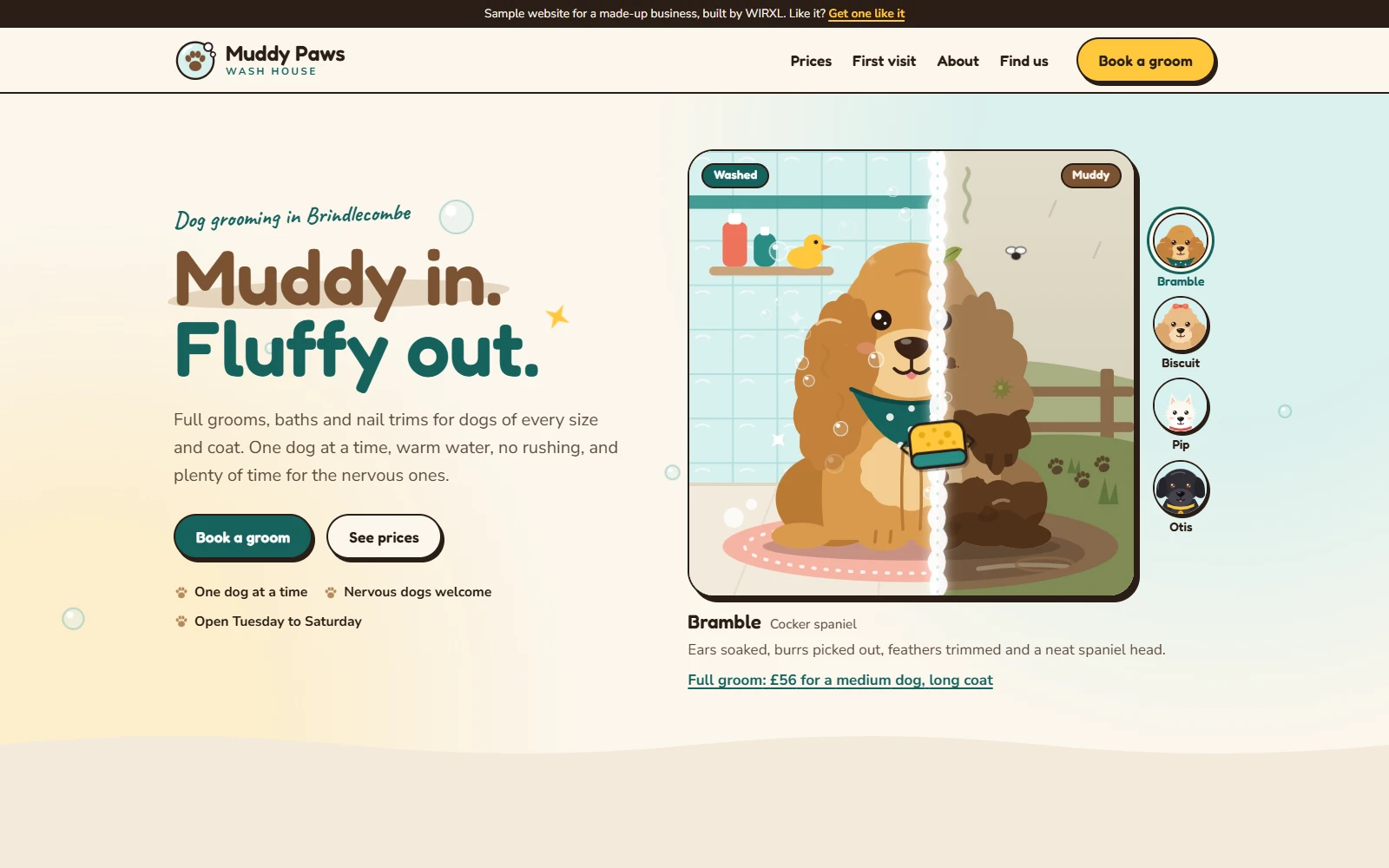
A sample website for a made-up dog groomer. Drag a sponge across a muddy dog to wash it clean.
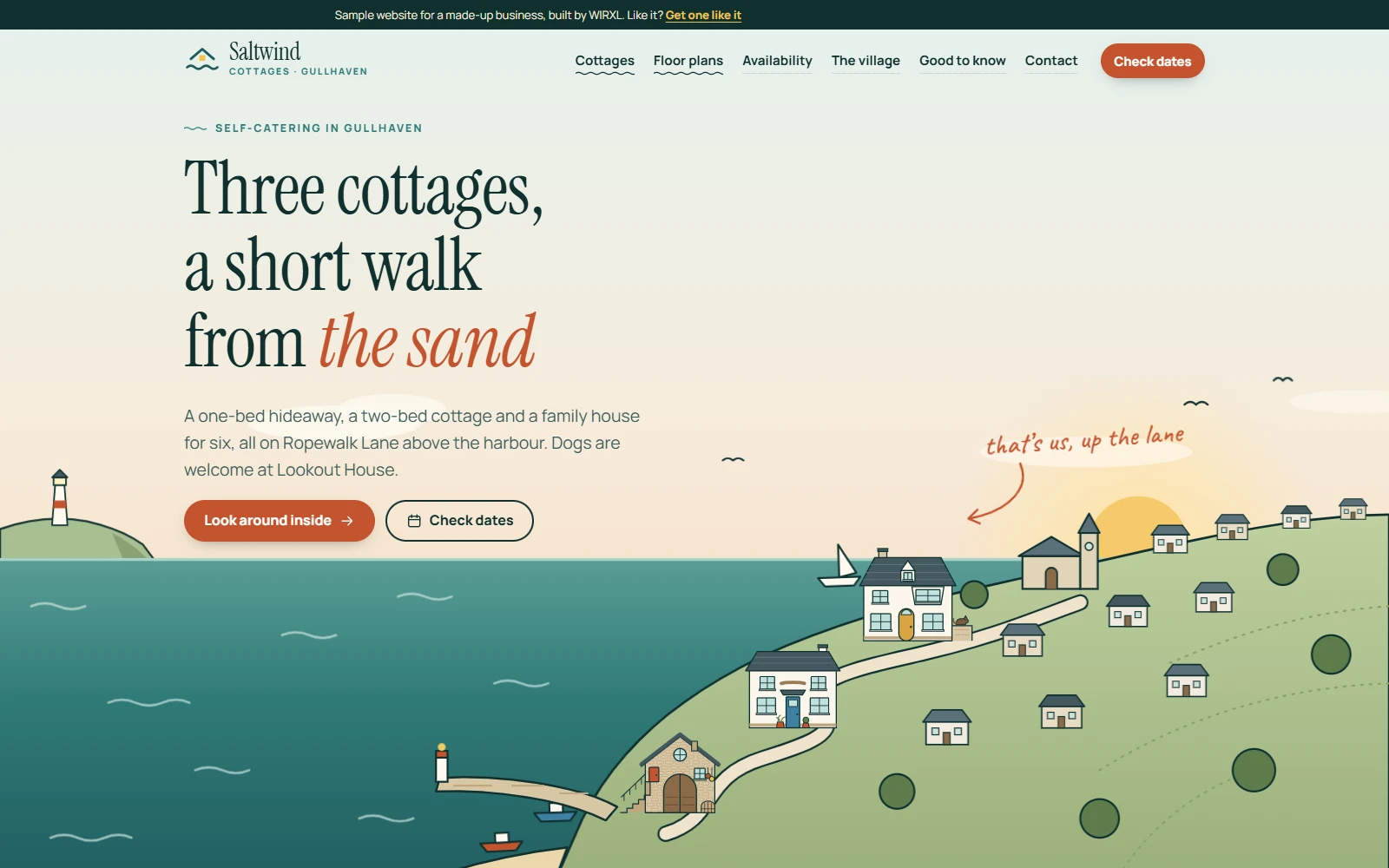
A website for three holiday cottages, where every cottage has a floor plan you can walk round before you book.
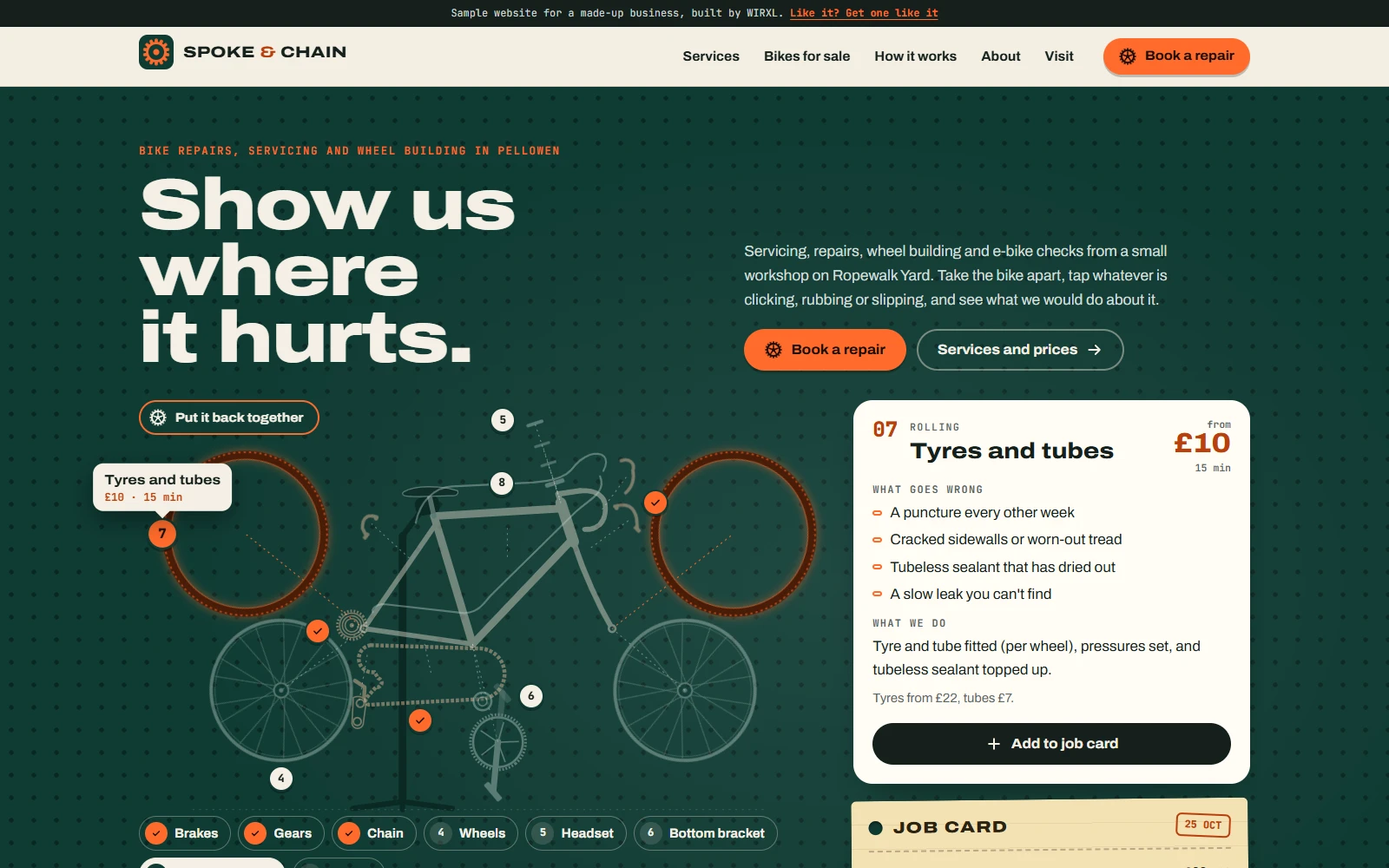
A sample site for a bike workshop: take the bike apart, tap the bit that's broken, see the price and book.
A website for a made-up driving instructor in a made-up town. The whole home page is one drive: a road winds down from the pupil’s front door, every section stands beside it as a road sign, and a little learner car follows the road as you scroll until it reverses into a bay next to the booking form.
Most driving instructor sites are a price list and a phone number. What an instructor actually sells is a calm hour in a car, so I wanted the page to feel like a short lesson. The car indicates before bends, gives way at a roundabout and finishes with a bay park, which felt like the right ending for this trade.
The page measures where each section sits and builds the road around them in SVG, with S-bends in the gaps. The car has its own track offset into the left lane, and a hand-made one round the roundabout so it keeps the island on its right.
The hard part was speed. If scroll position maps straight to height on the page, the car crawls down the straights and then shoots across every bend. So the scroll is matched to the track at the ends of each straight, and in between the car moves at a steady rate along the curve. The give way sits on top of that: the car slows to the line, waits while you keep scrolling, then pulls away slightly faster until it has caught up. A blue car is timed to cross in front of it before it goes. The indicators come from looking 150 px down the road and checking which way it turns.
On phones the road runs straight down the left edge and the roundabout becomes a crossroads. Bookings, edits and photos from the demo admin stay in the visitor’s own browser.
The cross traffic is tied to the scroll too, so if you scroll back up the blue car reverses all the way round the roundabout. It makes me laugh but it is plainly wrong, and it should probably just drive off.
ReactTypeScriptViteSVGlocalStorage
This one is for sale. The demo runs in your browser with made-up data, so try anything. There are two ways to have it:
Either way I can host it and look after it for a monthly fee, or hand everything over. Ask for a price.
A website for Bright Switch Electrical, a small domestic electrician in a made-up town called Larkmoor. It opens in the dark, with a torch glow following your mouse or finger and a wall switch beside the heading. Flick it and the light spreads out from the switch across the page while the lamps in the drawings warm up. It stays lit until you turn it off again.
Most electricians’ websites could belong to any trade. Swap the stock photo and the logo and you’d never know. I wanted one where the job itself was the idea, and for an electrician the light switch was sitting right there. It’s a sample, so a real electrician can have one like it: everything they’d change sits in one content file and one file of colours.
The switch is drawn in CSS and the click is made in Web Audio as it plays, two short bursts of filtered noise and a low knock, so there’s no sound file to load. The flood of light uses the View Transitions API. The page swaps to its lit colours and the new version is revealed through a circle that grows out of the switch. Browsers without it get a plain fade, and so does anyone who has asked for less motion.
The torch was the fiddly part. A dark overlay that hid the words would have failed on contrast, so it’s two big gradient layers moved with a transform: one darkens the room just enough, the other is screen-blended, which warms the background inside the beam without washing out the text.
The rough price builder is a fuse board. Each job is a breaker, and flicking one on picks a sensible default so the meter moves on the first click. Prices are ranges, summed and rounded outwards to the nearest £10, and the result can go off as an enquiry.
The owner’s admin is a demo. One tap gets you in. Edits stay in your browser (photos go in IndexedDB) and are merged over the site’s content everywhere. Send an enquiry and it turns up in the admin’s messages.
On a phone the torch only moves when you touch the screen. That’s right for a phone, but it loses some of the effect, and I’d like it to drift a little on its own.
ViteReactTypeScriptReact RouterVitest
This one is for sale. The demo runs in your browser with made-up data, so try anything. There are two ways to have it:
Either way I can host it and look after it for a monthly fee, or hand everything over. Ask for a price.
A website for Groove Vault, a made-up independent record shop in a made-up South West town. It sells new and second-hand vinyl, buys collections and puts on the odd Saturday gig. The front page is a crate of records you flick through like you would in a shop, and there’s a demo admin where you can play at being the owner.
Record shop websites tend to be a grid of thumbnails, which is about the least record-shop thing you can do. Half the fun of a shop is digging: tipping sleeves forward with two fingers and pulling one out because the cover caught your eye. I wanted the site to feel a bit like that while still telling you the dull things you came for, like the opening hours and whether they’d take your dad’s jazz collection.
The crate keeps one number for where you are, and every record’s tilt, height and shadow is worked out from how far it sits from that number. Dragging, swiping, the arrow keys and the easing animation all move that same number, so they can’t disagree with each other. A quick flick carries on for a few records; a pause before letting go doesn’t. Hover over the front record (or tap it on a phone) and it slides up out of the crate while the disc slides out of the sleeve and spins.
None of the sleeves are images. Each one is drawn from a style, a palette and a seed, so thirty-six made-up albums all look different, and a record added in the admin gets its own cover until the owner uploads a photo.
There’s no server. Admin changes and form messages are kept in your own browser and laid over the sample content, so you can mark a record sold, go back to the site and find the stamp on it.
Sound. A crackle when the needle drops would be lovely the first time and grating by the fifth, so I left it out. I’d still like to try it with a mute switch.
ReactTypeScriptViteReact RouterSVGIndexedDB
This one is for sale. The demo runs in your browser with made-up data, so try anything. There are two ways to have it:
Either way I can host it and look after it for a monthly fee, or hand everything over. Ask for a price.
A complete website for a dog grooming salon that doesn’t exist, set in a made-up town. It has prices by size and coat, a page on what a first visit is like, a booking request form and an admin the owner could run from a phone. A real groomer could have one like it with their own name, colours and photos.
Grooming is a trade where the result is the whole pitch: the dog that went in and the dog that came out. A gallery of before and after photos says that, but you scroll past it. I wanted the visitor to do the washing themselves, so the first thing on the page is a muddy spaniel and a sponge.
Each dog is drawn twice in SVG from the same skeleton, once fresh from a field and once fresh from the groom, and the clean one sits on top with a clip that follows the sponge. Because both versions share every coordinate, the line never makes anything jump. The fluffy edges, the westie’s tufty face and the mud splats come from small seeded path builders, so a new coat is mostly a few numbers. Bubbles and sparkles are plain DOM elements added as the line moves, rationed by distance travelled so a fast flick doesn’t flood the page.
On a phone only a sideways swipe washes, up and down still scrolls, and a tap glides the sponge to your finger. It is also a proper slider for keyboards and screen readers.
The admin is a demo: changes are kept in the visitor’s own browser, merged over the sample content, with photos shrunk and stored locally. Add a real before and after photo of a groom and it replaces the illustration.
Only four breeds are drawn, and the muddy versions are mostly the clean dog with duller fur and splats on top. A salon with good photos of its own grooms will beat the drawings anyway, so that’s where I’d point a buyer.
ReactTypeScriptViteSVGCanvas
This one is for sale. The demo runs in your browser with made-up data, so try anything. There are two ways to have it:
Either way I can host it and look after it for a monthly fee, or hand everything over. Ask for a price.
A website for Saltwind Cottages, a made-up set of three holiday lets on a lane above a harbour: a one-bed hideaway, a two-bed cottage and a family house where dogs are welcome. Each cottage has an illustrated floor plan, a calendar with real-looking bookings and seasonal prices, and a booking enquiry that lands in the owner’s admin.
Most holiday cottage sites are a carousel of wide-angle photos and a booking widget bolted on underneath. The questions guests actually ask are smaller than that. Which bedroom has the king-size bed? Is the log burner in the room with the sofa? Does the dog have to walk through the kitchen to reach the garden? A floor plan answers all of that at a glance, so I made the floor plan the front door.
The plans are drawn in SVG from data: rooms as rectangles (or an outline for the odd L-shaped landing) in units of ten centimetres, furniture placed and rotated inside each room, and doors and windows cut into the walls. The walls are drawn twice, a thick line round every room with the floors laid over half of it, then a thin line on top, which gives thick outer walls and thin inner ones without ever working out the outline of the building.
Hover or tap a room and a copy of it lifts out of the plan. Each wall of the room casts a strip down to where it was sitting, and only the strips on the far side show, so it reads as a block rising out of the drawing. The panel beside it shows a drawing of the room until the owner adds a photo.
The calendar knows that a booking holds nights rather than days, so the day someone leaves is half free and shows as a changeover. Prices come from seasons that can overlap (Christmas sits on top of winter), and the shortest stay depends on the season you arrive in. The made-up bookings come from a seeded random sequence starting on a fixed date, so they look the same whichever day you visit.
There’s no server. The admin keeps every change in your own browser and lays it over the original content.
A buyer’s floor plans still need me to draw them. A simple room-dragging editor in the admin would let an owner do it themselves.
ReactTypeScriptViteReact RouterSVG
This one is for sale. The demo runs in your browser with made-up data, so try anything. There are two ways to have it:
Either way I can host it and look after it for a monthly fee, or hand everything over. Ask for a price.
A website for a bike repair workshop that doesn’t exist. Spoke & Chain is a made-up business in a made-up harbour town, and the site is what a real workshop could have with its own name and prices on it. It opens with a drawing of a bike on a workshop stand that comes apart as you scroll.
Repair shop sites tend to list services in a table, and most people can’t tell whether their problem is “gears” or “cables”. I wanted the customer to point at the bit that’s clicking. Hover over the chain and it tells you what usually goes wrong with chains and what the job costs. One tap puts it on a job card, and the job card turns into a booking request.
The bike is one SVG with each repairable part in its own group. Every part has a vector for where it flies to, and a single number between 0 and 1 drives the lot. That number comes from the scroll position, or from the button, and each part runs a little behind the one before so they leave in order and land together. The transforms are written straight onto the SVG every frame instead of going through React, which kept it smooth. On a narrow screen there is a second layout where the parts drop onto a shadow board under the bike, like the painted outlines on a workshop tool wall.
The job card adds up labour and bench time, and if what you’ve picked is close to the price of a service that covers it, it says so. It’s the sort of thing a decent mechanic tells you at the counter.
There’s no server. All the content sits in one typed file, and the demo admin saves edits in your own browser (photos get shrunk and kept in IndexedDB), merged over that file everywhere on the site. Booking requests land in the admin’s inbox, so you can send one and watch it arrive.
The drawing is a road bike. A shop that mostly sees e-bikes or kids’ bikes would want its own, and right now that means redrawing the SVG by hand.
ReactTypeScriptViteSVGVitest
This one is for sale. The demo runs in your browser with made-up data, so try anything. There are two ways to have it:
Either way I can host it and look after it for a monthly fee, or hand everything over. Ask for a price.